
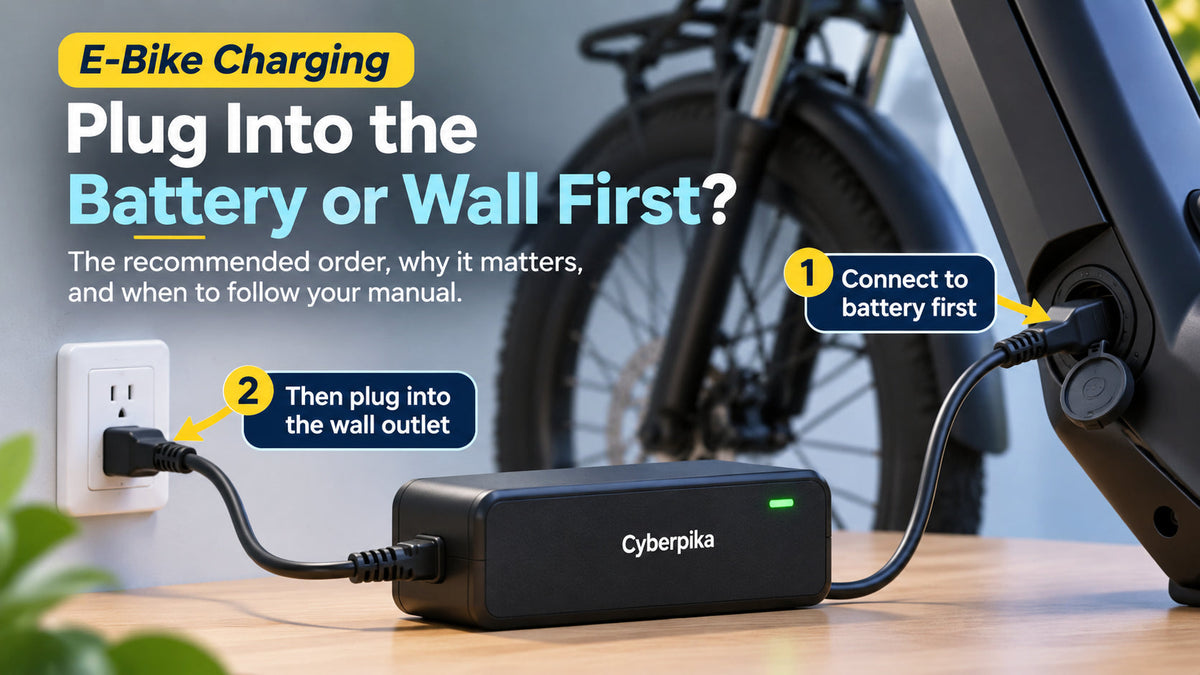
Most of us don't think much about the order when plugging in an e-bike charger. One end goes into the bike, the other into the wall. Does it really matter which one goes first?
Actually, it can.
For many conventional e-bike chargers, the recommended sequence is to connect the charger to the battery first, then plug it into the wall outlet. When you're done charging, reverse the order: unplug from the wall first, then disconnect from the battery.
There's a practical reason behind this.
Why battery first?
When a charger is already connected to a wall outlet, its DC output may be energized. Plugging it into the battery can sometimes create a small spark at the charging port.
This happens because of a sudden flow of current when the electrical connection is made. The technical term is inrush current.
A small spark doesn't necessarily mean something is wrong. But repeated sparking can gradually damage connector contacts, especially if the connection is loose or the pins are already worn.
Connecting the charger to the battery before turning on AC power may help reduce this type of sparking, depending on how the charger and battery are designed.
But some manufacturers say the opposite
Here's where things get a little confusing.
Some e-bike manufacturers recommend plugging the charger into the wall first, then connecting it to the battery.
That's because chargers aren't all designed the same way. Some have internal capacitors or startup circuits that behave differently depending on the connection sequence. Certain battery management systems (BMS) may also have specific requirements.
So while battery first is a common recommendation, it's not a universal rule.
If your bike or charger manual specifies a connection order, follow that instead.
What if you see sparks?
An occasional tiny spark may be related to inrush current, but don't assume every spark is harmless.
If you notice a strong spark, smoke, a burning smell, or discoloration around the charging port, stop using the charger immediately.
The problem could be something more serious, such as incorrect connector polarity, damaged contacts, or an electrical compatibility issue.
Also, keep in mind that two connectors can look identical and still have different electrical configurations. A plug that physically fits doesn't necessarily mean the charger is compatible with the battery.
A simple habit worth checking
For chargers designed for battery-first connection, the routine is easy to remember:
Starting a charge: Battery → Wall
Finishing a charge: Wall → Battery
It only takes a few seconds, and it may help reduce wear on your charging port.
Just check your charger and battery manuals first. The correct sequence depends on the equipment you're using.
And regardless of plugging order, always make sure the charger matches your battery's voltage, polarity, and other electrical requirements.
Sometimes the small details of charging are worth paying attention to.
Share:
How to Charge Your Himiway Ebike with GaN Technology: Cruiser, Escape, Zebra & Cobra (2026)